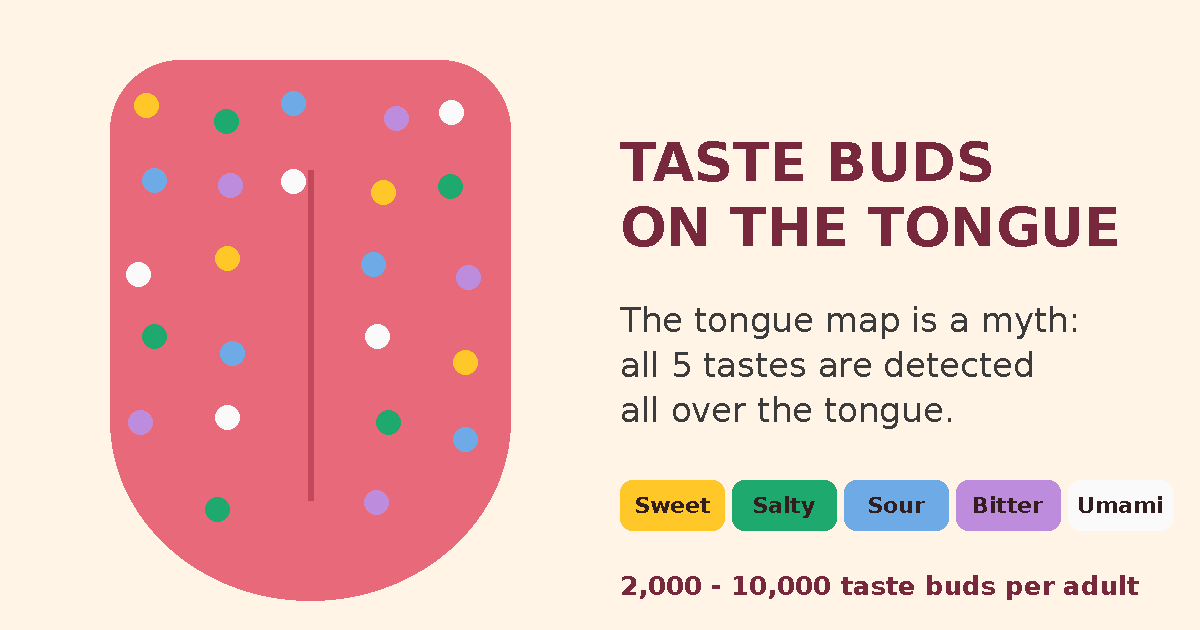
Remember that diagram from school? A tongue with neat little zones: sweet at the tip, salty and sour on the sides, bitter at the back. Many of us even did the experiment, touching bits of paper to a classmate’s tongue and nodding smugly when the “right” spot lit up.
It turns out that map is wrong. Your tongue is far more interesting than that diagram suggests.
In this guide, we’ll cover what taste buds are, how many you have, the types of taste buds on the tongue, which part of the tongue tastes sweet or spicy, and how a small graph from 1901 turned into one of the most durable myths in science class.
What Are Taste Buds?
Taste buds are tiny sensory organs that let you experience taste. They sit inside small bumps on your tongue called papillae. They tell you what you’re eating and whether it’s pleasant, and they act as a safety check too, flagging things like spoiled milk before you swallow them.
Each taste bud looks a bit like a rosebud or a peeled orange. At the top is a small opening called a taste pore, where food chemicals reach the cells inside. Each bud contains roughly 50 to 150 taste receptor cells, and these cells connect to nerves that send signals to your brain.
Taste buds aren’t only on your tongue, either. You also have them on the roof of your mouth (the soft palate) and in your throat.
How Many Taste Buds Are on the Tongue?
The average adult has somewhere between 2,000 and 10,000 taste buds. That’s a wide range, and it’s normal. Size and number vary from person to person, which is one reason two people can taste the same soup and disagree about how salty it is.
Children have more taste buds than adults, since we lose them as we age. That’s part of why kids can be so dramatic about bitter vegetables. After about age 50, taste can fade further as taste buds decline in number and sensitivity, and your sense of smell dulls too.
Types of Taste Buds on the Tongue
Strictly speaking, the “types” are the three kinds of papillae that house taste buds:
- Fungiform papillae sit on the tip and sides of the tongue. They hold roughly 1,600 taste buds.
- Circumvallate papillae sit at the back of the tongue and hold around 250 taste buds.
- Foliate papillae sit on the back sides of the tongue. There are about 20 of them, with several hundred taste buds each.
The tiny, rough bumps that give your tongue its texture are a fourth kind, called filiform papillae. They help you feel food, but they don’t contain taste buds.
The Five Basic Tastes
Your taste buds detect five basic tastes:
- Sweet: sugars, found in honey, fruit and ice cream.
- Salty: mostly table salt or mineral salts, like in pretzels and chips.
- Sour: usually acids, like the citric acid in lemons or the acetic acid in vinegar.
- Bitter: compounds from plants, caffeine and more. Coffee and dark chocolate are the classic examples, and whether you enjoy them varies a lot between people.
- Umami: the savory, meaty, brothy taste. Foods like mushrooms, tomatoes, fish and soy sauce are rich in glutamate, the compound behind it.
Real foods are almost never just one of these. A single bite can register as mostly sweet with hints of salty and umami, and that layering is what makes eating so interesting.
Which Part of the Tongue Tastes Sweet?
Here’s the short answer: all of it.
The school version says sweetness lives at the tip. In reality, sweet receptors are spread across the whole tongue, along with the rest of the mouth’s taste-bud territory. Researchers have found that everything we perceive as sweet can activate the same type of receptor, and that receptor isn’t confined to the front.
Try it yourself. Dab a little sugar or honey on the side of your tongue, or even toward the back. You’ll taste sweetness just fine.
Which Part of the Tongue Tastes Spicy?
This one has a fun twist: spicy isn’t a taste at all.
Your five taste categories are detected by taste buds. Spiciness, along with the feeling of hot or cold, is picked up by other cells in your mouth and throat that sense temperature and irritation. Cleveland Clinic notes that “hot” covers both temperature and spice, while “cold” covers both temperature and sensations like the cooling of mint or eucalyptus.
So there’s no “spicy zone” on your tongue. Chili heat can be felt on your lips, gums, the roof of your mouth and your throat, which is why a hot pepper can leave your whole mouth burning.
So Where Did the Tongue Map Come From?
The story is a classic case of a small finding getting blown out of proportion.
In 1901, German scientist David Hänig measured how much of a taste substance it took for people to notice it at different spots around the edge of the tongue. He found tiny differences in sensitivity. The tip and edges were slightly better at detecting certain tastes.
The trouble came in how the results were drawn. His graph showed changes in sensitivity for each taste separately, not compared against each other. In the early 1940s, Harvard psychologist Edwin Boring redrew it in a book, without a meaningful scale. That version made each taste’s most sensitive area look like a separate territory. Textbooks picked it up, and the myth stuck.
Scientists have been debunking it for decades:
- In 1974, researcher Virginia Collings confirmed that all tastes can be detected across the tongue.
- Two nerves carry taste signals, one for the front of the tongue and one for the back. If tastes were sectioned off, cutting the front nerve would erase one taste. It doesn’t.
- In a 1993 experiment, anesthetizing the front nerve didn’t stop people from tasting sweetness, and they even perceived it more intensely.
- Taste receptor proteins for each basic taste have since been found across all taste areas of the mouth.
Some regions are slightly more sensitive to certain tastes, and the sides of the tongue have more taste buds than the center. The back of the tongue is especially sensitive to bitterness, which makes evolutionary sense, since many toxic substances taste bitter and it helps to catch them before swallowing. But sensitivity is not the same as exclusivity.
Taste Isn’t Just Your Tongue
Flavor is a team effort. When you chew, food releases chemicals that reach your taste buds and also travel up to smell receptors in your nose. Your brain combines both signals into what you experience as flavor.
That’s why food tastes flat when you have a blocked nose. Smell problems from allergies, sinus infections or a cold are one of the most common reasons people feel their taste has changed.
What Can Affect Your Taste Buds?
Taste buds are surprisingly resilient. The cells renew about every 10 days, so a burned tongue usually heals quickly. Still, several things can dull or distort your sense of taste:
- Nasal congestion and smell problems
- Dry mouth
- Certain medications (hundreds can alter taste)
- Acid reflux (GERD)
- Gum infections and other dental problems
- Smoking and tobacco use, though taste improves after quitting
- Heavy alcohol use
- Vitamin B12 or zinc deficiency
- Chronic conditions like diabetes, kidney or liver disease, and neurological disorders
- Aging
Medical terms you may come across include hypogeusia (reduced taste), ageusia (complete loss of taste), dysgeusia (distorted taste) and phantom taste (a lingering taste with nothing in your mouth).
How to Keep Your Taste Buds Healthy
You can’t do much about age, but the basics help:
- Avoid tobacco.
- Limit alcohol.
- Brush your teeth, gums and tongue regularly.
- Let hot food and drinks cool before you dig in.
- Don’t press frozen items directly onto your tongue.
If your sense of taste changes and doesn’t bounce back, don’t shrug it off. A cause like a new medication or seasonal allergies is common and harmless, but a lasting change is worth checking with a doctor.
Quick FAQs
How many taste buds does the human tongue have?
Adults typically have 2,000 to 10,000 taste buds, with children having more.
What are the types of taste buds on the tongue?
Taste buds live in three kinds of papillae: fungiform (tip and sides), circumvallate (back) and foliate (back sides).
Does each part of the tongue taste something different?
No. The tongue map is a myth. All five tastes can be detected wherever there are taste buds, though some areas are slightly more sensitive to certain tastes.
Can you taste spicy food with your tongue?
Spiciness isn’t a taste. It’s a heat and irritation sensation detected by other receptors in your mouth and throat.
How often do taste buds regenerate?
About every 10 days, which is why minor injuries usually heal on their own.
Final Thoughts
The tongue map is neat, memorable and wrong. In reality, your tongue is a busy network of thousands of taste buds, all sharing the work, with your nose and your other senses joining in to build flavor.
So next time someone confidently tells you sweetness only lives on the tip of your tongue, you know the real story. Better yet, run the coffee-and-pretzel test on them.